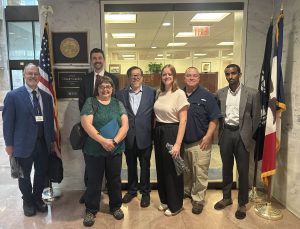
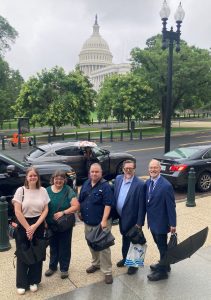
At the end of June Clayton County Energy District (CCED) Coordinator Kelsi Davis flew to Washington DC alongside a group of advocates from across the country including Steve Hopkins, Rural Energy for America Program (REAP) Manager/Coach with the Clean Energy Districts of Iowa (CEDI), John Nielson, Vice President of Operations and Sales at Perry Novak Electric, and Arla Wagner, a small business owner and REAP recipient from Lansing. The purpose of this visit to our nation’s Capital was to speak with legislators about reopening applications and reviews for REAP grants. For the last 24 years REAP grants from the United States Department of Agriculture (USDA) have supported small businesses and farmers by covering 25% of the costs to install renewable energy or improve energy efficiency thereby reducing operational costs. For the last 15 months, however, the USDA has been unable to review any applications.
REAP has brought significant investment to Northeast Iowa, with the 2nd Congressional District listed as the second highest recipient in the entire country. Between 2008 and 2025 District 2 received over $50 million in REAP grants. In 2024, REAP grants provided nearly $1 million in Clayton County alone. Over the next 25 years that $1 million investment will result in $4 million in energy savings, presenting opportunities for small businesses to expand their offerings, keep prices competitive, and provide more local jobs.
Without the ability to lower energy costs through REAP due to pauses in the program, rising costs for everyday necessities threaten small businesses and the long-term resilience of rural communities. Local energy contractors have also faced significant setbacks through cancelled contracts and lost revenue. John Nielson from Perry Novak Electric has secured over $7 million in REAP funding for their clients, but willingness to participate in the program has dropped significantly due to continued uncertainty. In addition, Perry Novak could offer 3-5 additional jobs if updated REAP regulations are issued. Supporting programs like REAP offers opportunities for prosperity, strengthening the local economy, self-reliance, job opportunities, and reducing strain on grid infrastructure.
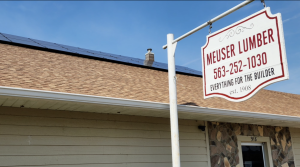 One recent story from Clayton County was Meuser Lumber in Guttenberg who used REAP to install solar on the roof of their hardware store offsetting just over 70% of their electric usage. The grant totaled $16,678 and with a tax credit further cutting costs, Meuser Lumber will save over $3,000 in energy costs annually. This reduces overhead costs by over $60,000 through the lifespan of the solar arrays. Family farmer Alex Schafers, located near McGregor, also decided to reduce his overall consumption by purchasing a more efficient grain dryer. The CEDI team designed a system to reduce his energy use by 73% or nearly $8,000 in savings each year. A REAP grant provided $23,387 of the upgrade cost, reducing Alex’s payback period to 12 years. Last harvest, Alex immediately noticed a 50% reduction in LP alone. Ultimately these savings will provide larger profit margins, supporting a shift to higher yielding corn varieties and more product to sell on the market.
CCED joined this effort because of stories like Meuser Lumber, Alex Schaefers, and countless others in Clayton County. These projects make a real impact in the community, strengthening the resilience of Iowa’s rural way of life. With the program paused and potentially thousands of applications unreviewed or requiring resubmission, many business owners may miss the opportunity entirely. By traveling to Washington DC and discussing the impact of this program in legislators’ home districts, CCED and its partners are working to bring REAP investments back to Iowa businesses. It’s easy to take energy for granted but REAP in the hands of local business owners ensures good, lasting work is accomplished.