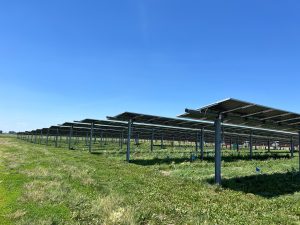
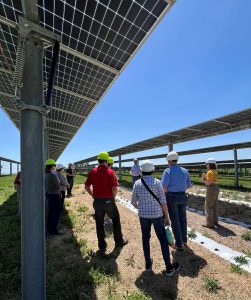
 Last week Clayton County Energy District (CCED) Coordinator Kelsi Davis attended a tour at the Iowa State University (ISU) and Alliant Energy agrivoltaics test site in Ames. Agrivoltaics combines solar energy production with livestock or crop production. Many large-scale solar operations require some type of vegetative site stabilization to ensure long term soil health. Sheep offer one alternative to frequent mowing of native grass mixtures, combining energy production with pasture grazing. The team at ISU, however, has experimented with different crops to find which varieties are most suited to agrivoltaics. In addition, they maintain bee colonies to pollinate the fruits and vegetables on site which also produces honey.
The research team has grown many varieties, but currently they are testing leafy greens, bell peppers, grapes, raspberries, tomatoes, pumpkins, and watermelon. Each crop variety has one plot underneath or between the arrays and one control group in direct sunlight. So far, the research has shown optimal results from the solar test plots. For example, the panels offer protection from the elements and even produce temperature differences in the space underneath them. In the winter, the area directly under the arrays maintains temperatures around 10 degrees warmer than exposed areas. This has allowed researchers to grow different varieties of grapes which otherwise die over cold Iowa winters. In another example, some crop varieties do just as well under the panels as they do in the direct sun, but in the case of bell peppers the slight shading they received produced more marketable produce with less sun damage. Finally, some varieties do better under the panels. Leafy greens grew larger faster and showed less evidence of pest damage. Raspberries planted on site produced 4 times more fruit under the panels than out in the open!
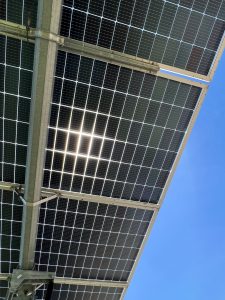 To determine optimal solar orientation, the ISU site incorporates two different types of solar arrays, both with bi-facial panels which collect sunlight from both sides. One half of the site features fixed panel arrays facing directly south and the other half utilizes tracking panels, orientated to follow the sun’s path from east to west through the day. The tracking panels produce more energy due to direct sunlight throughout the entire day, but they are more costly up front. Typically, developers need a larger site for the extra energy production gained from tracking panels to balance the additional cost. Both the fixed arrays and tracking arrays have two different panel heights, testing whether the amount of clearance space underneath the panels affects crop production. While fruit and vegetable production seems to thrive regardless of height, livestock grazing does require a higher clearance.
As the need for clean energy resources increases, land use in farming communities will continue to be a crucial consideration. Research facilities such as ISU provide valuable insight into how to balance energy and agriculture. By combining solar with crop production, livestock grazing, or native habitat we can create more diverse and resilient rural communities. The Clayton County Energy District continues to provide resources and technical assistance to drive the locally owned clean energy transition, including everyone in this investment toward the future.